.png)

Work Packages
Learn about and participate in our events.
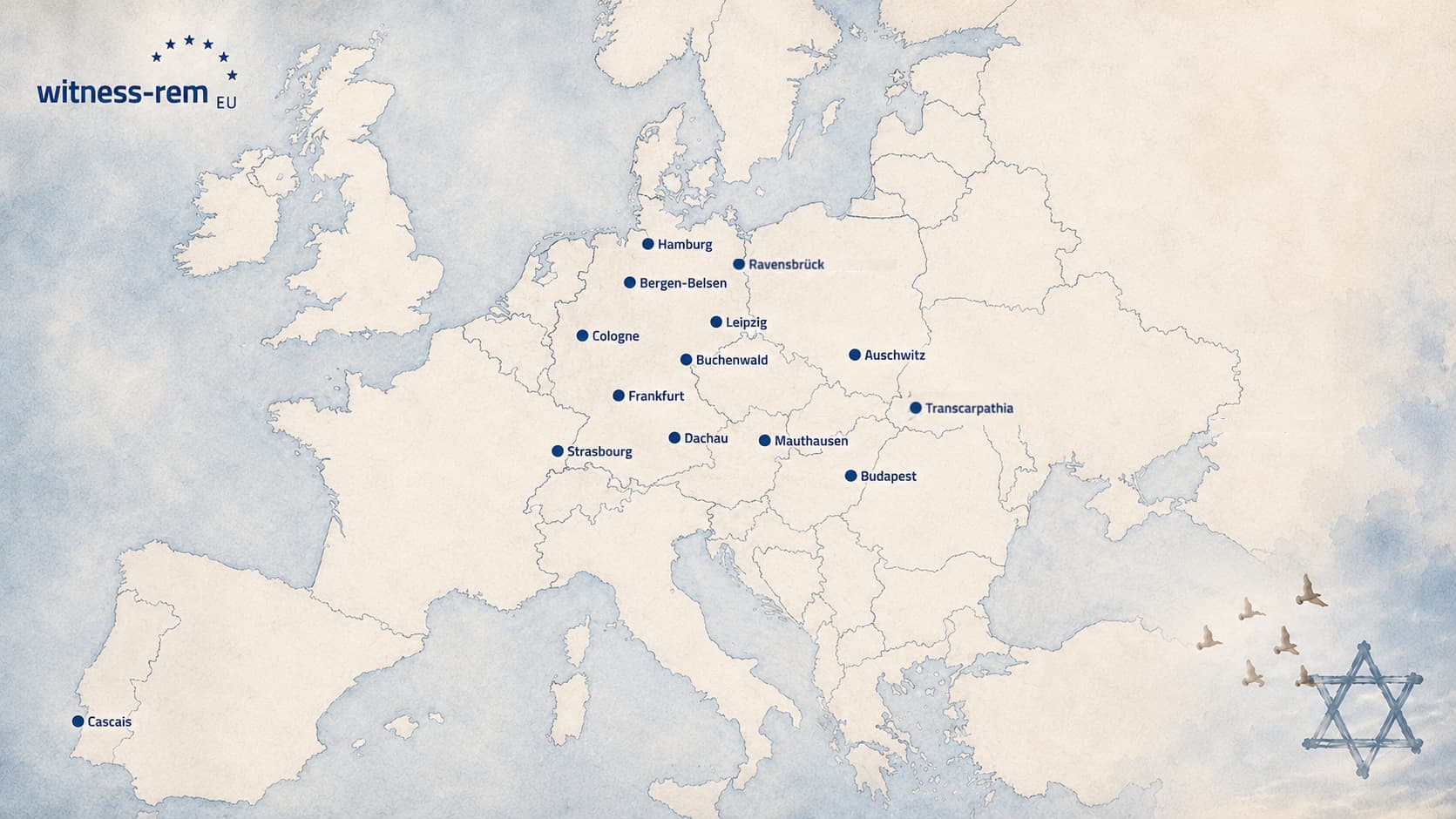
🌍 Our Locations
Click to open the interactive map
WP1 – Cascais (Portugal)
Detailed program and application form available →
Topic
Project Kickoff / In collaboration with the title-holding European Capital of Democracy 2026, Cascais (Portugal), we present the scope and aim of the project, with each regional partner sharing insights in their events. Thus, we create a Europe-wide narrative about the Holocaust.
Objectives
In collaboration with the title-holding European Capital of Democracy 2026, Cascais (Portugal), we present the scope and aim of the project, with each regional partner sharing insights in their events. Thus, we create a Europe-wide narrative about the Holocaust. The meeting can be "hybrid" (= two work packages, one in-situ in Cascais and one online), or online only.
WP2 – Online Event
Detailed program and application form available →
Topic
Project Kickoff / In collaboration with the title-holding European Capital of Democracy 2026, Cascais (Portugal), we present the scope and aim of the project, with each regional partner sharing insights in their events. Thus, we create a Europe-wide narrative about the Holocaust.
Objectives
In collaboration with the title-holding European Capital of Democracy 2026, Cascais (Portugal), we present the scope and aim of the project, with each regional partner sharing insights in their events. Thus, we create a Europe-wide narrative about the Holocaust. The meeting can be "hybrid" (= two work packages, one in-situ in Cascais and one online), or online only.
WP3 – Bavaria (Germany)
Topic
Workshop in Bavaria, followed by a visit to the Dachau Concentration Camp Memorial Site.
Objectives
Exploring the evolution of Nazi persecution policies from 1933 onwards using Dachau as a case study; analysing how early camps laid the foundations for later extermination policies. Focus on the role of law enforcement, bystanders and early resistance.
WP4 – Transcarpathia (Ukraine)
Topic
The life and role of the Jewish population of Transcarpathia within Transcarpathian society c conference
Objectives
Let's learn about the life of Jews in Transcarpathia and their role within the Transcarpathian community. Target group: Young people aged 18-30, survivors, their descendants, those interested in the topic.
WP5 – Budapest (Hungary)
Topic
Starred houses, ghetto, stumbling stones, shoes
Objectives
Learn how the Nazis rounded up Jews on the anniversary of the launch of the Swiss protected company. Target group: descendants of survivors.
WP6 – Webinar
Topic
Webinar: “Memories of Courage: Aristides de Sousa Mendes, the Holocaust and Today’s Challenges in Europe”
Objectives
Evoking the example of Aristides de Sousa Mendes as a European symbol of civic courage and commitment to human dignity.
Providing historical context on Portugal’s position during the Second World War and the Holocaust, reflecting on its significance for European remembrance.
Promoting a parallel with today’s challenges, highlighting the importance of hospitality, the celebration of cultural diversity and the defense of fundamental rights.
Inspiring young people and educators, through the Ubuntu pedagogy, to see themselves as bridge-builders and promoters of a culture of peace and cooperation.
Fostering transnational dialogue, reinforcing the shared remembrance of the Holocaust and its connection to today’s struggles against discrimination, exclusion and division.
WP7 – Saxony (Germany)
Topic
Workshop in Lower-Saxony, followed by a visit to Bergen-Belsen memorial.
Objectives
Using the site of Bergen-Belsen as a foundation, the workshop combines analogue and digital approaches to Holocaust remembrance. Pupils work with digital testimonies and historical material to understand both the systemic nature of persecution and the role of local populations. The active involvement of descendants of survivors allows for intergenerational dialogue. A core element is the critical reflection on complicity and moral agency—then and now.
WP8 – Budapest (Hungary)
Topic
House of Fates commemoration / Józsefváros railway station
Objectives
Where trains, i.e. cattle cars, departed for concentration camps - Holocaust Remembrance Day Int'l - Target group: addressing radical right-wing, Nazi-type ideologues
WP9 – Transcarpathia (Ukraine)
Topic
Visiting collection points in Transcarpathia
Objectives
Collection points and local camps were set up for Jews, from where they were transported to concentration camps. Visiting these places and learning about the historical events associated with them. Target groups: high school and university students, anyone who would like to learn more about the subject, and descendants of victims/survivors.
WP10 – North Rhine-Westphalia (Germany)
Topic
Workshop in North Rhine-Westphalia, with prior visit to local urban remembrance sites in Cologne (e.g. EL-DE-Haus, Stolpersteine)
Objectives
Investigating the role of urban populations during the Holocaust: How did ordinary citizens respond to persecution unfolding in their immediate environment? The workshop focuses on bystanders, helpers, and forms of resistance in urban contexts like Cologne. Through local case studies and site visits, students explore moral choices, civic courage and social pressure under dictatorship. The goal is to foster awareness of individual responsibility in past and present societies.
WP11 – Vienna (Austria)
Topic
NS discrimination politics, holocaust,
Objectives
Event should be organized in Vienna (Bruno Kreisky Forum, tbc) with school classes BEFORE a visit to Mauthausen concentration camp. Contacts to various schools across Austria exist from previous projects.
WP12 – Mauthausen (Austria)
Topic
Visit to Mauthausen concentration camp
Objectives
Learning about concentration camps and Nazi hatred on Holocaust Remembrance Day in Hungary. Target group: young people aged 13–22
WP13 – Online Event
Topic
Online Event 1 addressing interested public, multipliers (teachers, NGOs) with focus on AT, DE and Europe on findings and methodology of NS and holocaust didactic.
Objectives
Online Event 1 addressing interested public, multipliers (teachers, NGOs) with focus on AT, DE and Europe on findings and methodology of NS and holocaust didactic. The challenge to include migrants from countries with an antisemitic tradition and/or experience of political violence and authoritarian regimes into the Austrian and wider European narrative of NS-History and Holocaust remembrance.
WP14 – Thuringia (Germany)
Topic
Workshop in Thuringia, with prior visit to Buchenwald concentration camp memorial site
Objectives
Empowering students to become active agents of Holocaust remembrance through creative expression: Participants engage with survivor testimonies, historical sources, and local memory culture (e.g. Buchenwald) to develop visual materials—such as posters, reels or short videos—for use in schools and on social media. The workshop links historical knowledge with civic engagement and equips young people to counter Holocaust distortion in digital spaces through their own voices and media literacy.
WP15 – Transcarpathia (Ukraine)
Topic
Open day showcasing the deportation of Jews from Transcarpathia
Objectives
Organization of an open day presenting the deportation of Jews from Transcarpathia, which will include a conference and an accompanying exhibition presenting artifacts and publications related to the deportation. Target group: high school and university students and anyone who would like to learn more about the subject.
WP16 – Hamburg (Germany)
Topic
Workshop in Hamburg, with prior visit to Neuengamme concentration camp memorial site
Objectives
Focusing on the transmission of Holocaust memory to the third generation: How do grandchildren of survivors engage with the past, and what responsibilities arise for those with no direct family connection? Using Neuengamme and other local sites of memory as reference points, the workshop explores the educational and symbolic power of memorials. Students critically examine how spaces of remembrance shape collective memory, identity, and civic responsibility in contemporary society.
WP17 – Brandenburg (Germany)
Topic
Workshop in Brandenburg, with prior visit to Ravensbrück women’s concentration camp memorial
Objectives
Examining the often-overlooked experiences of women during the Holocaust and their role in post-war remembrance: The workshop highlights the gendered dimensions of persecution, including sexual violence, forced sterilisation, and maternal separation. Participants explore how women have shaped Shoah memory—as victims, survivors, rescuers, and later as educators and transmitters of memory. A focus is placed on the intersection of gender, identity and historical injustice, encouraging critical reflection and inclusive remembrance practices.
WP18 – Vienna (Austria)
Topic
Forms of holocaust remembrance in Austria since 1945.
Objectives
Event should be organized in Vienna (Bruno Kreisky Forum, tbc) with school classes AFTER a visit to Mauthausen concentration camp. Contacts to various schools across Austria exist from previous projects.
WP19– Budapest (Hungary)
Topic
Visiting memorial sites in Budapest
Objectives
On the anniversary of the launch of the Swiss protected military company, we visit the replica of the Mauthausen memorial on the banks of the Danube, the memorial wall in the Kozma Street cemetery, the Emanuel memorial tree in Dohány Street, and the Holocaust Documentation Center. Target group: children of survivors, reaching out to the distant generation
WP20– Online Event
Topic
Online Event 2 addressing interested public, multipliers (teachers, NGOs) with focus on AT, DE and Europe on findings and methodology of NS and holocaust didactic.
Objectives
Online Event 2 addressing interested public, multipliers (teachers, NGOs) with focus on AT, DE and Europe on findings and methodology of NS and holocaust didactic. The challenge to include migrants from countries with an antisemitic tradition and/or experience of political violence and authoritarian regimes into the Austrian and wider European narrative of NS-History and Holocaust remembrance.
WP21– Hesse (Germany)
Topic
Workshop in Hesse, with prior visit to the Jewish Museum Frankfurt and local memorials
Objectives
Exploring the continuity and rupture of Jewish life in Germany before and after 1945: What was lost, what survived, and what was rebuilt? Students engage with personal stories, local history, and cultural revival to understand both historical trauma and resilience. The workshop also equips participants to critically examine and challenge persistent antisemitic myths and conspiracy narratives in contemporary discourse, especially in the context of social media and political populism
WP22– Mauthausen (Austria)
Topic
Visit to Mauthausen concentration camp, unveiling of memorial plaque
Objectives
The only missing memorial plaque is the replacement and unveiling of the plaque honoring Hungarian Jewish martyrs, with the involvement of domestic Jewish organizations and the Hungarian government on Holocaust Remembrance Day in Hungary. Target group: all participants in the series of events.
WP23– Saxony (Germany)
Topic
Workshop in Saxony, with prior visit to local Shoah remembrance sites in Leipzig (e.g. Stolpersteine, former deportation points)
Objectives
Understanding local Jewish history and the erasure of Jewish life in Saxony; comparing past antisemitic propaganda with present-day online hate speech. Participants will develop strategies to counter Holocaust denial and distortion in digital spaces.
WP24– Auschwitz (Poland)
Topic
Visit to the Auschwitz concentration camp
Objectives
The majority of Jews from the Carpathian Basin were sent to Auschwitz, and our goal is to enable participants in the series of events to see the site of these terrible events for themselves. Target group: all participants in the series of events.
WP25– Strasbourg (France)
Topic
Project Closing / In collaboration with the Congress and Youth Center of the Council of Europe in Strasbourg, the findings and insights from the project activities will be presented by all partners to all key audiences and relevant stakeholders on the local/regional, national and European level.
Objectives
In collaboration with the Congress and Youth Center of the Council of Europe in Strasbourg, the findings and insights from the project activities will be presented by all partners to all key audiences and relevant stakeholders on the local/regional, national and European level.
WP26– Online Event
Topic
Project Closing / In collaboration with the Congress and Youth Center of the Council of Europe in Strasbourg, the findings and insights from the project activities will be presented by all partners to all key audiences and relevant stakeholders on the local/regional, national and European level.
Objectives
In collaboration with the Congress and Youth Center of the Council of Europe in Strasbourg, the findings and insights from the project activities will be presented by all partners to all key audiences and relevant stakeholders on the local/regional, national and European level.