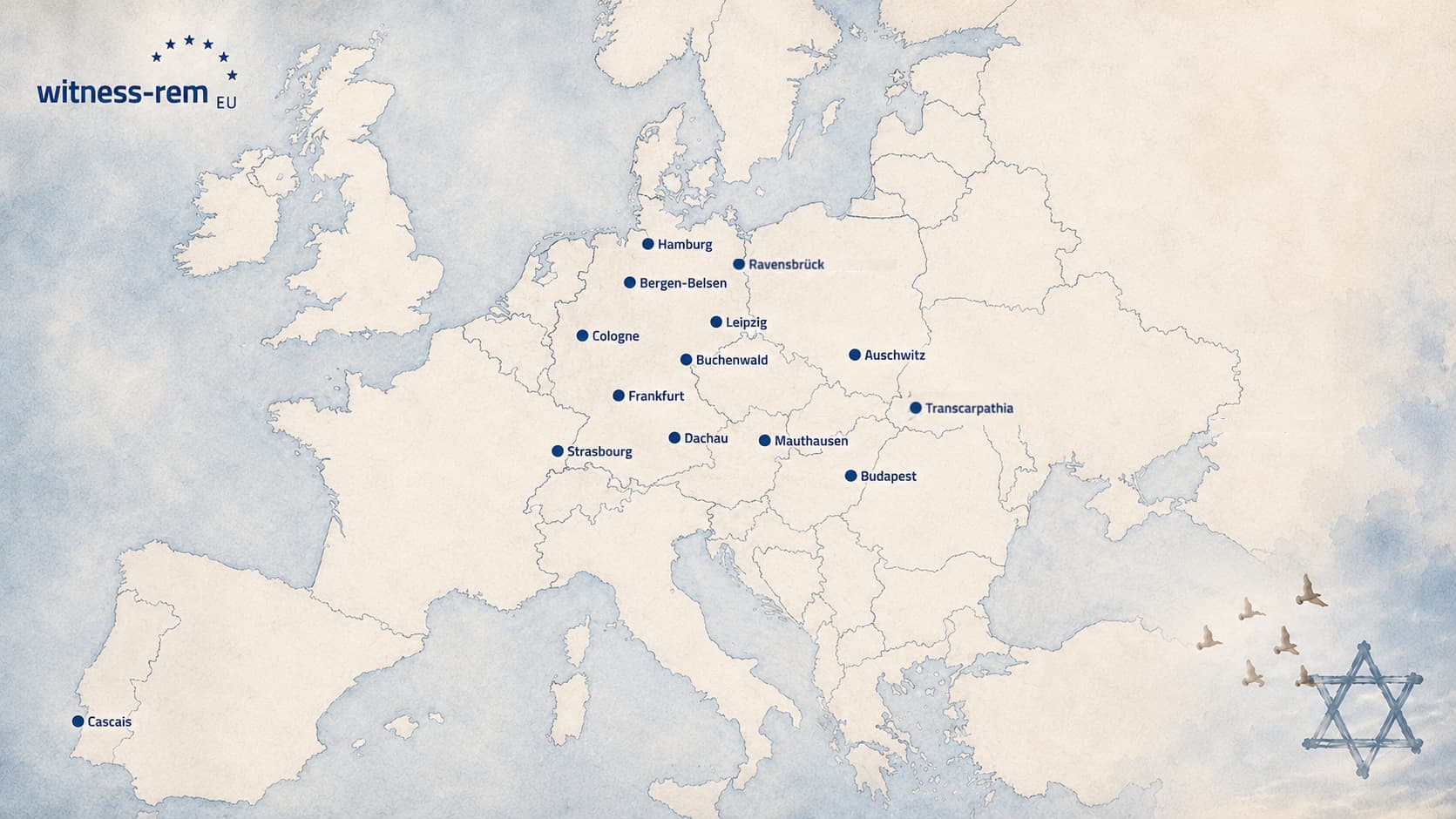

The project is a collaboration of 6 organisations from 5 countries (Hungary, Germany, Austria, Ukraine, Portugal) where we have sought to develop a partnership that allows the widest possible European cooperation both horizontally and vertically. Each organisation has an excellent knowledge of the civil society in its country, is able to reach a wide audience and through the joint project we will be able to share the synergies and take them forward in the long term.
Project Coordinator
The Central-European Club Pannonia Association (KEP Association) (COO) is a non-party, nongovernmental organisation whose basic aim is to foster international and Central European relations in accordance with the standards of the European Union and to cooperate with the Association's foreign and domestic sections, representations and partners.To this end, it carries out its activities primarily in the fields of economic life, science, environmental protection, culture, historical traditions, tourism, Hungarian nationality affairs, information exchange and public information.
Consortium member
The Deutsche Gesellschaft e. V. (BEN) is a non-profit organisation committed to promoting European integration and critical dialogue on political, cultural and social issues. Through a wide range of educational formats, it seeks to foster democratic engagement, historical awareness and civic participation. The association organises public conferences, seminars, exhibitions and publications that address European history, memory, and current challenges to democracy and pluralism. Cooperation with other non-profit educational institutions, associations and civil society actors is a central part of its work. Based in Berlin, the Deutsche Gesellschaft e. V. provides a forum for German and European dialogue, encouraging exchange across generations, disciplines and national borders.
Consortium member
ECoD NPO is a non-profit organisation promoting democratic governance and social cohesion through participation and awareness across the Council of Europe member states. As initiator of the European Capital of Democracy initiative, with Barcelona (2023/24), Vienna (2024/25), and Cascais (2026) as title-holding cities, ECoD has established the European City Network, linking participation and democracy departments from 24 municipalities in 15 countries together with more than 100 partner organisations. Within this community of practice, ECoD has delivered over 25 trainings and webinars since 2021 for municipal staff, youth leaders, and CSO practitioners, covering citizen assemblies, youth participation, digital engagement, civic education, and countering disinformation. Specific formats include hybrid training for young changemakers in seven EU Member States (TALE – Take the Lead in EU Elections), immersive school workshops on European values (“Democracy & You”), and “Local Labs,” where diverse stakeholder groups co-create tangible solutions to local challenges. . Furthermore, ECoD NPO has standing communication and cooperation partnerships with DG Comm at the European Commission and the European Parliament, as well as the Council of Europe.
Consortium member
Foster Europe (FE) established 2009, is an independent, non-partisan, private, and charitable AT Foundation to further European integration, participation, democracy, regional capacity, Integration and human and fundamental rights. It is headed by an educated historian with active research, teaching, and publication track record in NS-History, European Integration History, and Democracy Studies. While working in a panEuropean framework, FE concentrates its work on Central and Eastern Europe. FE has organized international projects and large-scale events since 2009 in an intercultural and intergenerational framework. Since 2011 FE has had an additional emphasis on promoting participative political culture in Europe, widening public knowledge and interest in the EU. FE creates international connections among CSOs, active citizens, youngsters, scholars, intellectuals, practitioners, and institutions from different societies and fields. Civic participation, networking of NGOs as well as the policy fields in question have been elements of FE's work. Foster Europe has for a long time cooperated with the Council of Europe, Directorate General II – Democracy, and the Congress of Local and Regional Authorities.
Consortium member
The IPAV is a non-profit civic association, recognized as a public utility organization (IPSS) and a Non- Governmental Organization for Development (NGDO). Its mission is to promote and restore Human Dignity, by creating the conditions necessary to reveal and repair the diminished or invisible value of every human being through empowerment and intervention in social systems, developing projects based on interdependence and capable of generating meaning and purpose. It does so by working toward the construction of a world of hope, where each person is recognized for their unique and inalienable value. IPAV believes that human dignity is not only a right but also the foundation for a full and meaningful life. Therefore, it creates initiatives that foster respect, inclusion, and opportunity, helping each individual to live authentically, in alignment with their potential and dignity. IPAV is thus committed to transforming realities and inspiring a more just and humane future. It specializes in training and capacity-building; foresight and diagnosis; knowledge production; on-the-ground project implementation; and the design and execution of events. IPAV is grounded in five core values that guide its structure, organization, and interactions: unity in diversity, care, collaboration, trust, and agility. In today’s complex and fragmented world, the multiple and varied violations of human dignity are the central problem that IPAV seeks to address through its mission. Two clear and concrete responses emerge: collaboration, as a primary means of responding to complex realities, and unity in diversity as a desirable and viable response to increasing social fragmentation. Accordingly, IPAV places strategic focus on the concepts of Ubuntu and Integrated Governance (GovInt). Since 2010, IPAV has developed and consolidated social innovation projects based on these two innovative and essential concepts.
Consortium member
The KMTT (Transcarpathian Hungarian Tourism Council) (BEN) was established in 2014 by a resolution passed at the inaugural general meeting, whose main goal is to create a broad-based cooperation that brings together Hungarian-speaking players in the Carpathian tourism industry. The primary task of the organization is to develop a competitive and sustainable tourism destination management organization that contributes to improving the quality of tourism services and increasing the sustainability of tourism in Transcarpathia through coordinated planning and development. The tasks of the Transcarpathian Hungarian Tourism Council include the tasks of the Carpathian Hungarian Tourism Council include the development and coordination of tourism in the region, as well as the representation of local professionals and organizations interested in tourism. All this is not only important from a tourism perspective, as in the long term it greatly contributes to strengthening the identity of the Hungarian community living here and to the economic convergence of the region. Since its establishment, the KMTT has implemented numerous programs that contribute to the development of tourism in Transcarpathia and provide opportunities for Hungarian businesses in Transcarpathia involved in tourism to become competitive in the region. The Transcarpathian Hungarian Tourism Council is a county-level umbrella organization for tourism, whose members can be Hungarian non-profit organizations, tourism institutions, businesses, entrepreneurs, and individuals involved in tourism in Transcarpathia. The organization currently has nearly 500 members.