.png)

Proposal
Learn about the WITNESS-REM project
Abstract
The project WITNESS-REM seeks to strengthen Holocaust remembrance across Europe by addressing alarming gaps in historical knowledge, rising antisemitism, and the risks of distortion and denial.
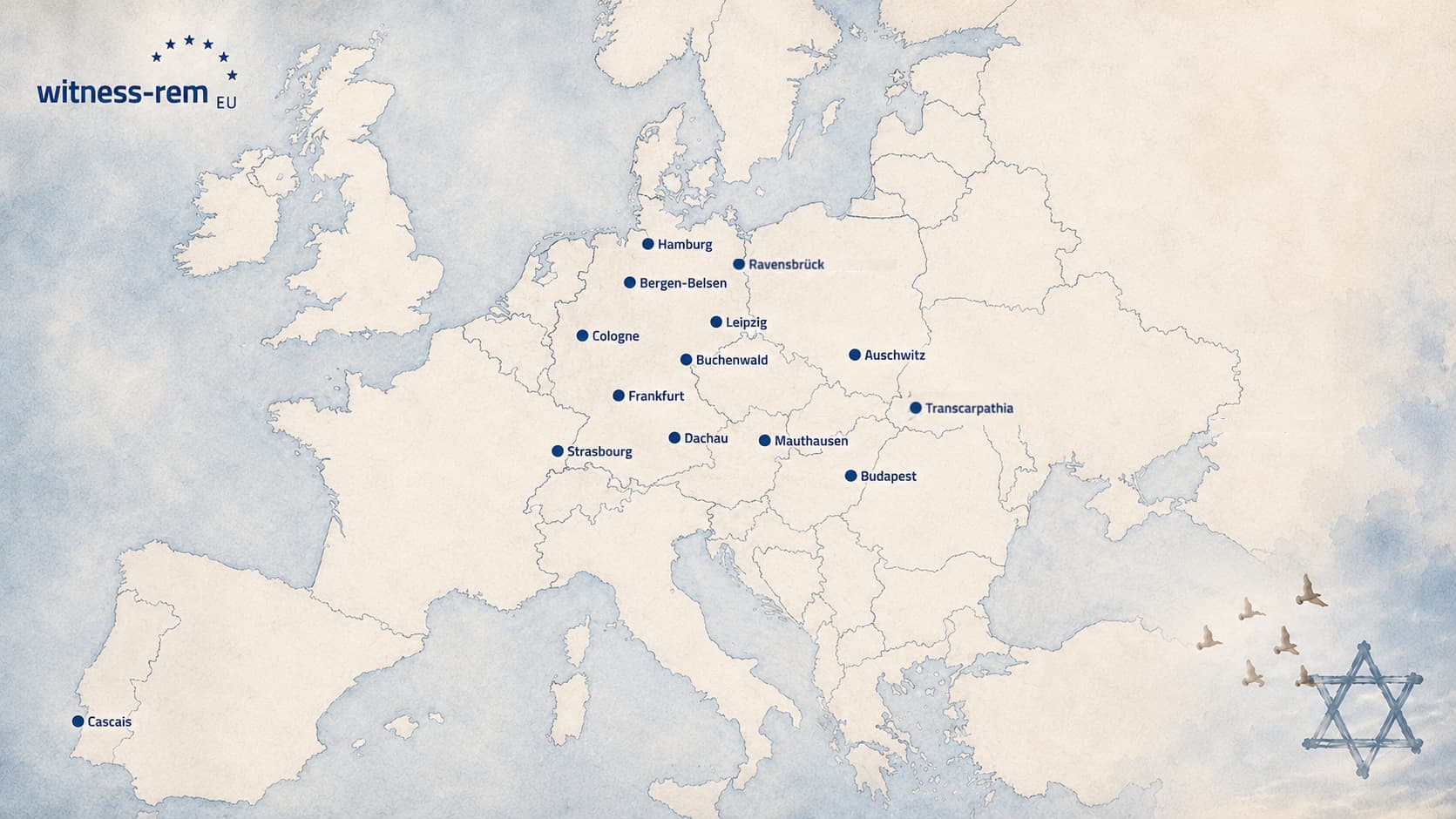
Through a transnational consortium of partners from Hungary, Austria, Germany, Ukraine, and Portugal, the initiative combines in-situ remembrance, intergenerational dialogue, and innovative digital tools to foster awareness, empathy, and democratic resilience among young people aged 13–22, descendants of survivors, and communities at large. WITNESS-REM develops 26 work packages (2026–2028) that integrate study visits to concentration camps, ghettos, and memorials with urban memory initiatives, digital archives, webinars, and peer-to-peer workshops. Starting in Cascais, the European Capital of Democracy 2026, and closing in Strasbourg at the Council of Europe’s Congress and Youth Centre, the project anchors remembrance in symbolic European spaces while ensuring wide geographic and cultural reach. Participants will critically engage with history through survivor testimonies, creative writing, simulation games, and structured dialogues with peers, including those vulnerable to radicalization. By combining factual learning with interactive methods, WITNESS-REM equips young ambassadors to transmit Holocaust memory within schools, communities, and networks. Its inclusive and gender-sensitive approach ensures accessibility for diverse participants, including marginalized groups, and highlights overlooked narratives such as women’s and children’s experiences during the Holocaust. The project delivers durable outcomes—digital exhibitions, toolkits, and ambassador networks—that extend beyond the funding period. In doing so, it reinforces the EU Strategy on Combating Antisemitism (2021–2030), promotes pluralism and human rights, and contributes to building a shared, democratic European memory culture resilient against hate, disinformation, and extremism.
Participants
List of participating organisations
-
1.
Central-European Club Pannonia Association Coordinator
-
2.
Deutsche Gesellschaft e.V. Partner
-
3.
Hungarian Tourism Council of Zakarpattya Partner
-
4.
ECOD Gemeinnützige GmbH Partner
-
5.
Foster Europe Foundation for Stronger European Cooperation Partner
-
6.
Instituto Padre António Vieira Partner
Background and general objectives
World War II and the Holocaust are the darkest chapters in European history, leaving wounds that remain open to this day.
The murder of six million Jewish children, women, and men, as well as the indifference and
active participation of local societies, are lessons that must be passed on to future generations. However,
recent research (Claims Conference 2023, DeZIM 2023) shows that there is a significant lack of knowledge
among younger generations about the basic facts of the Holocaust, while historical revisionism, relativization,
and the presence of extremist antisemitic movements are on the rise.
The aim of this project is to strengthen Holocaust remembrance in Europe, to counteract the
distortion of historical facts, and to foster a culture of respect for human rights, pluralism, and
democracy. The project is directly aligned with the objectives of the CERV-2025-CITIZENS-REMHOLOCAUSTJEW
call by:
● Remembrance by creating opportunities for collective and personal engagement with sites of stories,
memories, and survivor testimonies.
● Education by equipping young people with factual knowledge, critical thinking skills, and the ability to
recognise, address, and challenge denial and relativization.
● Digital tools by using innovative platforms (interactive digital archives, social media campaigns, etc.) to
expand reach and relevance for younger audiences.
● Youth as ambassadors by preparing young participants to act as multipliers in schools, communities,
and networks.
The project focuses on groups who are strategically positioned to sustain Holocaust memory into the present
and future:
1. Descendants of survivors that carry memories, enable intergenerational dialogue, and personal
storytelling.
2. Young people aged 13-22 who at that critical period go through identity formation, where exposure to
accurate history builds awareness against disinformation.
3. The “distant generation” (children of descendants) who ensures the continuity of memory across
multiple generations
4. Youth with limited knowledge of the Holocaust who often are vulnerable to disinformation and
stereotypes.
These groups are prioritized because they combine urgency, potential impact, and moral
responsibility. Educators, local municipalities, and communities will be engaged indirectly through
partnerships with schools, universities, NGOs, and cultural institutions across the partner countries.
The project involves partners from Hungary, Austria, Germany, Ukraine, and Portugal, enabling dialogue
between diverse historical narratives, from countries deeply marked by Nazi occupation to those still dealing
with suppressed or politicized memory. This transnational cooperation ensures that participants do not only
encounter “their” national history, but also the way Holocaust studies are shaped, and continue to be shaped.
By linking local remembrance initiatives to a European conversation, the project also contributes to the EU
Strategy on combating antisemitism and fostering Jewish life 2021-2030, and complements related EU
frameworks such as No Place for Hate: A Europe United Against Hatred, the European Democracy Shield,
and Gender Equality Strategy (2020-2025) (see section 1.3 further elaboration). Under the lead of KEP
Association in Hungary, a transnational exchange will create new perspectives, building on previous projects
(e.g. FREI - From Resistance to European Integration), existing partnerships and connections between
members from the European City Network.
WITNESS-REM’s objectives are translated into a coherent series of 26 work packages implemented between
2026-2028. These combine in-situ remembrance activities (visits to concentration camps, ghettos,
memorials, and deportation sites) with urban memory initiatives (Jewish quarters, commemorative plaques),
and online webinars reaching educators, NGOs, and young multipliers. Starting in Cascais, the European
Capital of Democracy 2026, and closing in Strasbourg at the Council of Europe’s Congress and Youth Center,
the project is firmly anchored in symbolic European spaces. The work package structure ensures a wide
geographic reach and allows for a dialogue between diverse historical narratives and contemporary
challenges.
The project will not end with the funded activities, it will rather produce durable resources, from digital content,
toolkits and resources to youth ambassador networks, that can be utilized by schools, universities, NGOs,
memorial and cultural institutions after the project’s conclusion. Results will also be shared and discussed
within the European City Network (currently 24 cities from 15 countries, with new cities joining annually) and
presented in the European Capital of Democracy 2028 (to be selected in March 2027).
WITNESS-REM is committed to inclusion and accessibility, ensuring participation of young people from
diverse socio-economic backgrounds, involving both Jewish and non-Jewish communities, and designing
activities accessible to those with disabilities. The project will integrate gender perspective across its design,
implementation, and evaluation, in line with the requirements of the call.
All communication, dissemination, and monitoring activities will be designed and implemented in a nondiscriminatory
and gender-sensitive approach, including the use of inclusive language and diverse visual
representation. Participation will be tracked and recorded with gender-disaggregated data and unintended
negative effects will be actively avoided in line with the “do not harm” approach.
Concept and methodology
The project applies to a methodology grounded in contemporary history research and experiential learning, combining engagement with primary historical resources, such as texts, photographs, audiovisual material, oral testimonies of survivors and descendants, with modern didactic and interactive tools.
Participants engage in study tours to remembrance sites and European institutions, dialogues with
contemporary witnesses, debates with peers from other countries, discussions with political decision-makers
and academics, and alternative pedagogical activities, such as creative writing, and simulation exercise.
This approach ensures that participants not only acquire factual knowledge but also experience the historical
and moral dimensions of the Holocaust.
A central feature of the methodology is active learning and peer-to-peer education. Participants study their
national narratives, then share and discuss their findings with peers at international meetings, creating a
multi-perspective, pan European discourse. Digital tools amplify this engagement, enabling participants to
present debates, findings, and creative projects to a wider audience through online exhibitions, videos, and
social media content. By linking archival and oral sources to participants’ local environments, the project
allows them to contextualize the history of discrimination, totalitarianism, democratic struggle, and European
integration within their immediate communities, fostering deeper understanding and civic responsibility.
Processing historical sources is complemented by intergenerational dialogue. Listening to contemporary
witnesses and descendants enables participants to connect to historical facts, strengthening empathy and
memory transfer. Creative and digital tools allow young people to actively produce knowledge and
share it with their wider networks, generating a multiplier effect across schools and communities.
Moderated discussions are designed not for immediate persuasion but to confront disinformation with
evidence and to promote reflection, critical thinking, and empathy.
The project follows a chronological historical arc, from early making of victims through deportations to
extermination, allowing participants to understand the systemic logic of Nazi terror rather than isolation
events. Inputs from vulnerable groups, experts, and European institutions such as FRA, EP, COE, and ECHR
provide additional contextual and normative perspectives, linking local memory work to European democratic
values.
Ethical and safety considerations are central to the methodology. All activities respect the memory of
victims and survivors, employing trauma-sensitive approaches, trained facilitators, and the presence of
psychologists when necessary.
Integration of gender perspectives is mainstreamed throughout the methodology. Historical sources are
analyzed with attention to the experience of women, girls, and other marginalized groups; peer-to-peer
learning ensures balanced participation of all genders; creative outputs challenge gender stereotypes and
facilitators are trained in gender-sensitive moderation. Monitoring indicators include gender balance in
participation, quality of contributions, and the level of empowerment and engagement of female participants.
The comprehensive methodological framework transforms Holocaust education into a lived, interactive,
and reflective experience. It ensures that knowledge acquisition is paired with personal involvement, empathy
and civic responsibility, producing lasting impact on participants’ attitudes, behaviors, and capacity to act as
multipliers in their communities.
Impact and ambition
The project is designed to create short-, medium-, and long-term effects on young people, descendants of Holocaust survivors, and broader European communities, while actively promoting gender equality and non-discrimination.
Short-term impact (during the project and immediately after completion):
All participants, especially young people (aged 13–22) will significantly expand their knowledge of the
Holocaust, engaging directly with historical sources, on-site learning at memorials, and personal accounts
from contemporary witnesses. Descendants and children of survivors will be able to preserve and transmit
communal memory, reinforcing intergenerational dialogue.
Participants who hold radical right-wing or extremist views will be confronted with historical facts in structured,
moderated discussions, fostering critical reflection and empathy. Additionally, participants acquire concrete
skills, including digital content creation, research, critical thinking, and peer-to-peer teaching, enabling them
to communicate their learning to wider audiences. Gender-sensitive facilitation ensures balanced
participation of young women and men, with inclusive approaches for participants from diverse social
backgrounds and those with disabilities.
Medium-term impact (1-3 year after the project):
Participants act as multipliers in their communities and schools, sharing experiences and insights gained
during the project. Digital materials, including an online exhibition, extend the reach of the project beyond
direct participants, preserving and disseminating Holocaust memory. Transnational collaboration fosters trust
and the development of shared historical narratives among the counties involved, providing a model for other
EU Member States and promoting cross-border dialogue and understanding.
Long-term impact:
The project aims to cultivate a younger generation of European ambassadors for Holocaust remembrance,
capable of countering historical revisionism, denial, and anti-Semitism. It contributes to the consolidation of
a common, pluralistic European historical narrative, strengthening civic responsibility and democratic
engagement. By emphasizing the role of social indifference in historical atrocities, the project reinforces
participants’ commitment to human rights, the rule of law, and active democratic participation.
Changes affecting direct target groups:
Participants, especially young audiences, will develop deeper historical knowledge, empathy, critical thinking,
and a capacity to act as multipliers within their peer networks. Descendants and children of survivors will
experience strengthened community identity and intergenerational dialogue. Participants with radical views
will engage with historical facts, fostering reflection and challenging entrenched prejudices.
Promotion of gender equality and non-discrimination:
The project ensures balanced gender participation, equal opportunities for young women and men, and
barrier-free access for participants from diverse social and cultural backgrounds. Specific attention to gender,
age, and social status enhances the inclusion of multiple perspectives, reducing inequalities and enriching
the collective learning experience.
Innovation and ambition:
The project goes beyond traditional commemoration by combining interactive, participatory, and digitally
transferable methods. Its innovative aspects include structured dialogue with radicalized youth, the
integration of creative digital tools, and a European-level narrative framework that links local histories to a
shared continental memory. By fostering debate, empathy, and active engagement, the project seeks to
transform Holocaust education, strengthen democratic resilience, and reduce the spread of anti-Semitism,
setting a precedent for future transnational educational initiatives.
Sustainability and continuation
The long-term impact of the project is anchored in the fact that participants are not merely beneficiaries of a one-off program, but become active multipliers, sharing the knowledge and experiences they gain with their communities, schools, and youth organizations.
The interactive and digital outputs—such as the online
exhibition, short videos, and methodological materials—will remain accessible beyond the project’s lifetime,
ensuring extended reach and sustained educational impact.
Ensuring continuity and sustainability:
● The consortium partners commit to maintaining the digital platform created during the project for at
least five years, continuously expanding the available content and resources.
● Teaching aids and methodology packages will be freely available to experts, scientists, teachers
and civil society organizations, allowing use across different countries and contexts.
● Selected young participants will be trained and supported as “European Ambassadors of Holocaust
Remembrance”, ensuring the intergenerational transfer of memory and knowledge.
● ECoD NPO will include the projects’ resources into its online best-practice showroom, embed the
topic into the ongoing work of the European City Network and continue the discussion with suitable
(young) audiences during the Democracy Years in title-holding cities.
Required resources:
● Partners will contribute their human and organizational capacity to maintain and expand project
outputs.
● Project results will be integrated into partners’ existing activities, including school programs, civil
society events, and commemorative initiatives.
● Additional support from EU and national funding programs (e.g., Erasmus+, Europe for Citizens,
national cultural funds) will be sought to sustain and scale project activities.
Synergistic connections:
● The project complements and reinforces the EU Strategy for Combating Antisemitism (2021–2030)
and other education and remembrance programs.
● Digital and methodological outputs can be adapted and used in other EU-supported initiatives,
particularly in youth, education, and human rights projects.
● Long-term, the project fosters transnational dialogue on memory policies, enabling participants to
jointly develop synthesized, multi-faceted narratives. This process helps reduce historical
competition, strengthens pluralistic European values, and consolidates a common understanding of
the past.
Through these mechanisms, the project ensures that its outcomes, enhanced Holocaust knowledge, critical
thinking, empathy, and democratic engagement, are not limited to the immediate participants, but continue
to influence European civic education and memory culture for years to come.